


Already purchased? To view Sign In
AI Fundamentals Crash Course একটি সম্পূর্ণ বেসিক-টু-ফাউন্ডেশন লেভেলের কোর্স, যেখানে আপনি শিখবেন কীভাবে Artificial Intelligence (AI) কাজ করে এবং আধুনিক AI টুল ও সিস্টেমের মূল কনসেপ্টগুলো পরিষ্কারভাবে বুঝে নিতে হয়—একেবারে শূন্য থেকে।
AI can be classified into three main categories based on its capabilities and level of intelligence:
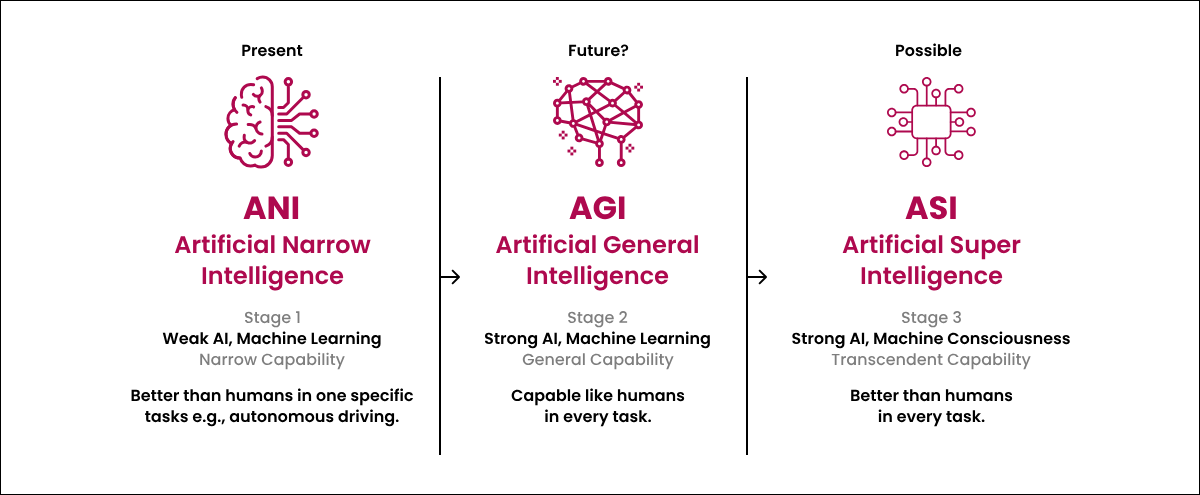
Definition: AI designed and trained for a specific task or a narrow set of tasks.
Characteristics:
Highly specialized and efficient within its domain.
Cannot perform tasks outside its trained scope.
No understanding or consciousness.
Examples:
Siri, Alexa, and Google Assistant.
Recommendation engines on Netflix, YouTube, or Amazon.
Spam filters in email systems.
Definition: AI with the ability to perform any intellectual task that a human can do.
Artificial General Intelligence (AGI)
Characteristics:
Possesses problem-solving ability across domains.
Can learn, adapt, and apply knowledge in varied contexts.
Mimics human-like reasoning and decision-making.
Examples:
Still theoretical; researchers are working towards it.
A true general-purpose AI that could switch from solving math problems to writing poetry.
Definition: A level of AI that surpasses human intelligence in all aspects—creativity, reasoning, problem-solving, and even emotional intelligence.
Characteristics:
Exceeds the combined intelligence of humanity.
Could create its own innovations beyond human comprehension.
Raises ethical and existential concerns.
Examples:
Currently hypothetical, often discussed in AI ethics and philosophy.
Popular in science fiction (e.g., AI that takes control of systems globally).
